

Pork Market 2026: Navigate Shifting Trade Dynamics And Changing Consumer Dietary Preferences
Pork Market Growth
Pork Market Analysis
Pork Market Trends
The Business Research Company's Pork Market Report 2026 – Market Size, Trends, And Global Forecast 2026-2035
LONDON, GREATER LONDON, UNITED KINGDOM, March 9, 2026 /EINPresswire.com/ -- Pork Market to Surpass $295 billion in 2030. In comparison, the Meat Products which is considered as its parent market, is expected to be approximately $1,269 billion by 2030, Pork Market market to represent around 23% of the parent market. Within the broader Food And Beverages industry, which is expected to be $8,783 billion by 2030, the Pork Market market is estimated to account for nearly 3% of the total market value.
Which Will Be the Biggest Region in the Pork Market in 2030
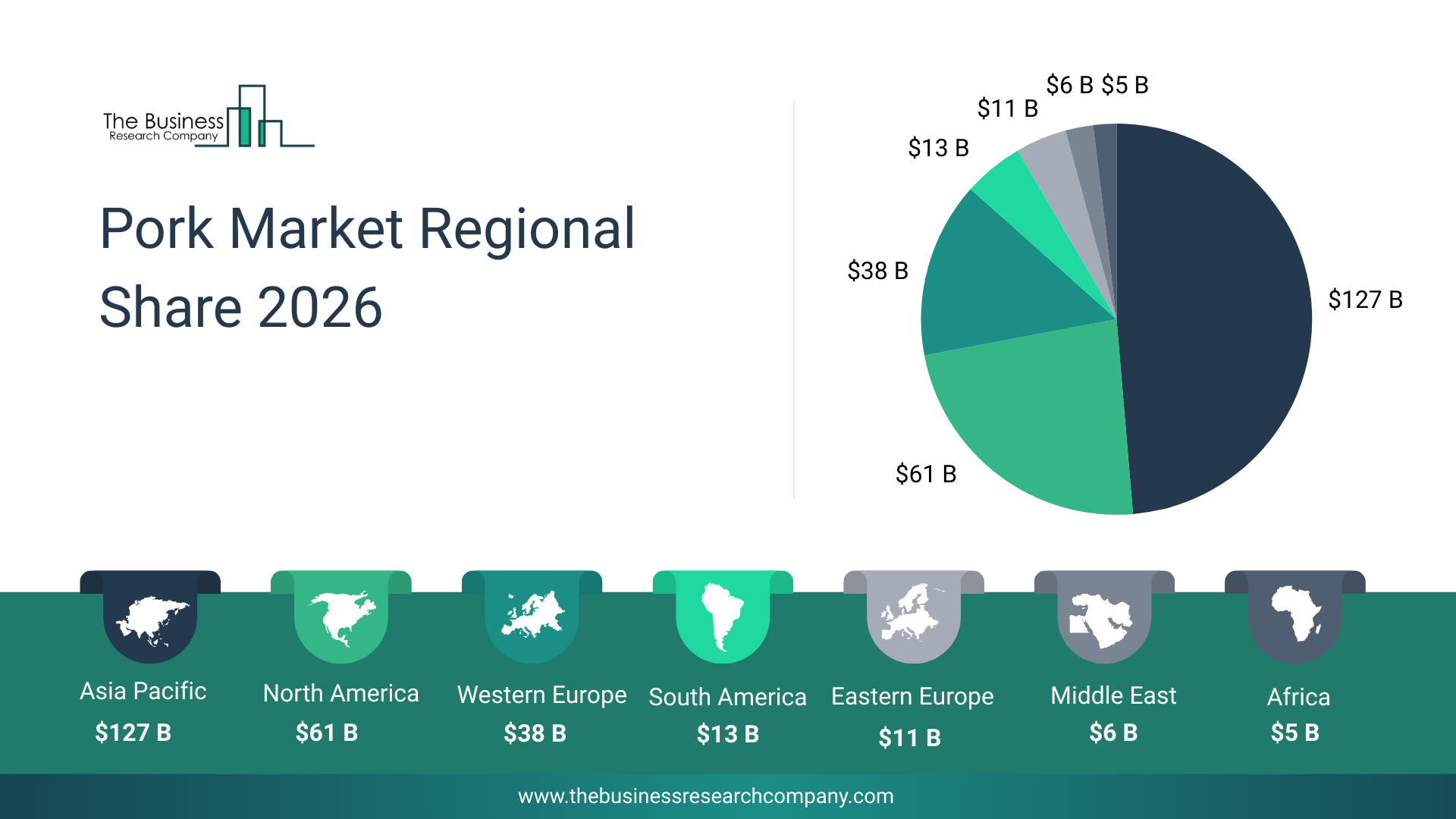
Asia Pacific will be the largest region in the pork market in 2030, valued at $143,587 million. The market is expected to grow from $123,255 million in 2025 at a compound annual growth rate (CAGR) of 3%. The steady growth can be attributed to the increasing penetration of online meat delivery platforms and increasing investment in livestock farming and meat production.
Which Will Be The Largest Country In The Pork Market In 2030?
China will be the largest country in the pork market in 2030, valued at $85,177 million. The market is expected to grow from $74,437 million in 2025 at a compound annual growth rate (CAGR) of 3%. The steady growth can be attributed to the increasing penetration of online meat delivery platforms and favorable government initiatives.
Request a free sample of the Pork Market report:
https://www.thebusinessresearchcompany.com/sample_request?id=9726&type=smp&utm_source=EINPresswire&utm_medium=Paid&utm_campaign=Mar_PR
What will be Largest Segment in the Pork Market in 2030?
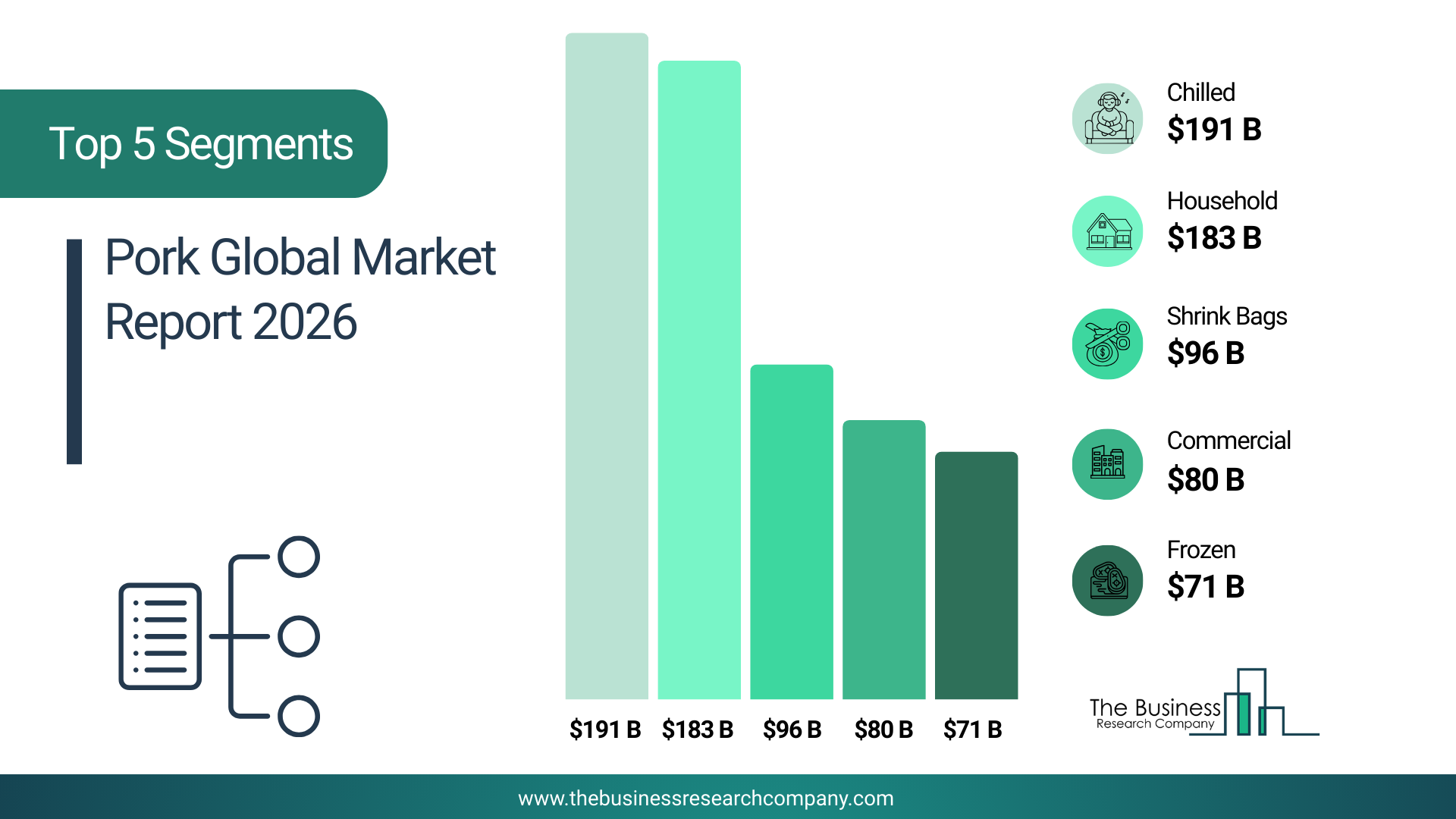
The pork market growth is by type into chilled and frozen. The chilled market will be the largest segment of the pork market segmented by type, accounting for 72% or $211,202 million of the total in 2030. The chilled segment will be supported by rising consumer preference for fresh-tasting meat with superior texture and flavor compared to frozen alternatives, increasing use of chilled pork in household cooking as a convenient daily protein, growing adoption by foodservice operators who value shorter preparation time and consistent quality, rising demand for premium and “fresh” positioned meat products in urban retail, increasing focus on cold-chain distribution that enables safe chilled pork availability in supermarkets and growing consumer perception that chilled meat offers better nutritional retention and fewer quality losses than frozen pork. Chilled pork offers fresher, safer, and higher-quality meat compared to frozen alternatives. It also supports premium retail positioning, enables better texture and flavor retention, and meets rising consumer preferences for minimally processed products. Additionally, chilled pork aligns well with expanding cold-chain infrastructure and the rapid growth of modern supermarkets, convenience stores, and online grocery platforms. As the dominant format, chilled pork maintains steady demand, particularly in regions with strong fresh meat preferences. However, its market share is slowly eroding as frozen options gain traction. Growth is stable but consistently lags behind the frozen segment, indicating a gradual consumer shift.
The pork market is segmented by packaging into store wrap, modified atmosphere packaging, vacuum packaging, shrink bags and others. The shrink bags market will be the largest segment of pork market segmented by packaging, accounting for 35% or $102,586 million of the total in 2030. The shrink bags market will be supported by increasing use of tight-fitting barrier bags that minimize drip loss and freezer burn for pork cuts, rising demand from processors for packaging that conforms closely to irregular and bone-in products such as ribs and hams, growing preference for packs that enhance visual appeal through high clarity and gloss on retail shelves, increasing focus on extending shelf life by limiting oxygen ingress and moisture loss, rising utilization of shrink bags for both fresh and frozen pork across global supply chains and growing adoption in export-oriented plants that need puncture-resistant solutions for heavy and bulky pork products. Shrink bags extend the shelf life of pork by providing strong oxygen and moisture barriers that reduce spoilage. They tightly conform to cuts, minimizing purge loss and enhancing product appearance for retail. Their durability and lightweight design also improve cold-chain efficiency and reduce packaging costs. Shrink bags represent the workhorse packaging for bulk and commercial applications. Growth is moderate but steady, supported by foodservice and industrial meat processing. This segment benefits from cost-effectiveness and reliability for large-volume handling.
The pork market is segmented by application household and commercial. The household market will be the largest segment of the pork market segmented by application, accounting for 69% or $203,406 million of the total in 2030. The household market will be the supported by rising use of pork as an affordable staple protein in everyday home meals, increasing household preference for versatile cuts suitable for diverse cuisines and cooking styles, growing middle-class incomes that support higher per-capita pork intake, rising availability of chilled and frozen pork through modern retail and e-commerce channels, increasing demand for pre-cut and conveniently packed portions that suit small families and growing consumer awareness of safe, packaged pork replacing informal and unbranded meat purchases.
What is the expected CAGR for the Pork Market leading up to 2030?
The expected CAGR for the pork market leading up to 2030 is 3%.
What Will Be The Growth Driving Factors In The Pork Market In The Forecast Period?
The rapid growth of the global pork market leading up to 2030 will be driven by the following key factors that are expected to reshape food processing efficiency, livestock management, and global protein supply chains worldwide.
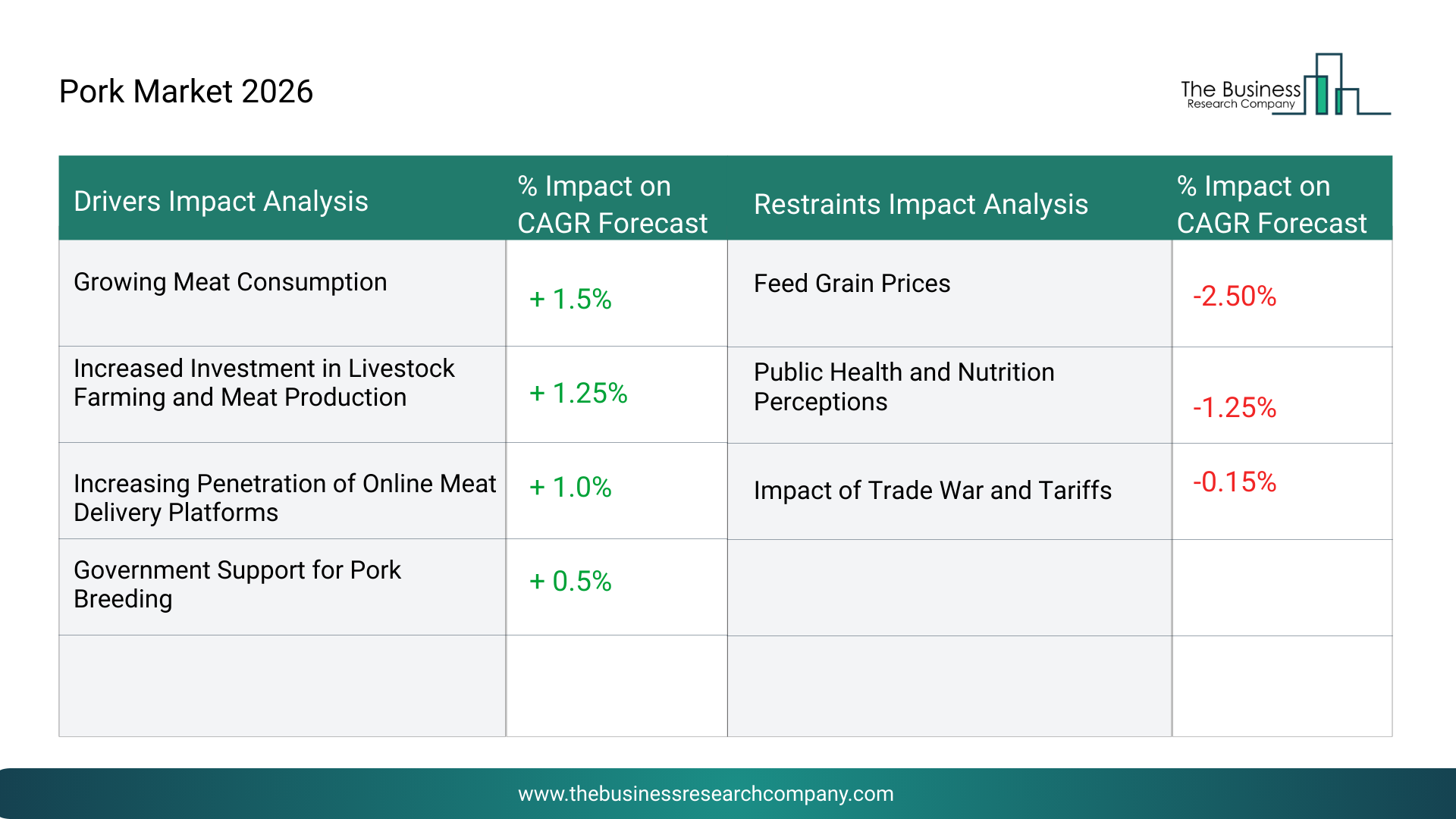
Growing Meat Consumption – The growing consumption of meat will propel the growth of the pork market. Rising incomes, urbanization, and shifting dietary preferences are driving consumers toward higher protein intake, increasing demand for a wide range of animal-source foods. Pork, being one of the most widely consumed and versatile meats worldwide, is well positioned to benefit from this trend, particularly in regions where population growth and economic development support greater meat purchasing power. As households expand their protein consumption and incorporate more meat into daily diets, the need for reliable, affordable, and high-quality pork products rises correspondingly. This ongoing shift toward meat-centric eating patterns strengthens demand across fresh, chilled, and processed pork categories. As a result, growing consumption of meat is anticipated to contributing to a is 1.5% annual growth in the market.
Government Support For Pork Breeding - government support for pork breeding will propel the growth of the pork market. As policymakers strengthen incentives for livestock development, including subsidies, preferential credit access, and agricultural-equivalent status for animal husbandry activities, pork breeding becomes more financially attractive and scalable for producers. These supportive measures encourage investment in improved breeding facilities, better feed systems, and upgraded farm infrastructure, ultimately enhancing productivity and herd quality. Additionally, the expansion of government-backed programs aimed at modernizing livestock management and promoting rural economic development increases the capacity of breeders to meet rising demand for high-quality pork. As more regions implement favorable policies to boost domestic meat production and reduce reliance on imports, government-led support will play a central role in expanding pork supply, improving production efficiency, and driving the growth of the pork market. Consequently, government support for pork breeding is projected to contributing to a 1.3% annual growth in the market.
Increasing Penetration Of Online Meat Delivery Platforms - The increasing penetration of online meat-delivery platforms will propel the growth of the pork market. As consumers increasingly rely on digital channels for grocery and fresh-food purchases, online platforms offer convenience, assured quality, and rapid delivery that align with shifting lifestyle preferences. The integration of cold-chain logistics, real-time tracking, and hygienic handling protocols enhances consumer confidence in purchasing fresh pork online. Moreover, quick-commerce growth enables wider access to pork products across urban and semi-urban areas, expanding market reach beyond traditional retail outlets. As these platforms continue to scale and diversify their product assortments, the availability of fresh, chilled, and processed pork becomes more consistent and accessible, thereby driving the growth of the pork market. Therefore, increasing penetration of online meat-delivery platforms is projected to contributing to a 1.0% annual growth in the market.
Increased Investment In Livestock Farming And Meat Production - Increased investment in livestock farming and meat production will propel the growth of the pork market. As producers and governments channel more capital into farm infrastructure, improved breeding systems, feed supply, and animal-health measures, pork production capacity will expand and become more efficient. Such investments help raise productivity, reduce costs, and support scale-up of pig farms and processing units, making pork more available and affordable to meet rising demand. With improved farming practices and supply-chain capabilities, producers will be better positioned to supply fresh, chilled, and frozen pork to both domestic and international markets. As a result of these investments, the pork market is expected to grow steadily. Consequently, increased investment in livestock farming and meat production is projected to contributing to a 0.5% annual growth in the market.
Access the detailed Pork Market report here:
https://www.thebusinessresearchcompany.com/report/pork-global-market-report?utm_source=EINPresswire&utm_medium=Paid&utm_campaign=Mar_PR
What Are The Key Growth Opportunities In The Pork Market in 2030?
The most significant growth opportunities are anticipated in the household pork market, the chilled pork products market and the modified atmosphere packaged pork market. Collectively, these segments are projected to contribute over $64 billion in market value by 2030, driven by expanding cold-chain logistics, rising demand for premium and traceable meat products, and increasing consumption of ready-to-cook and ready-to-eat protein foods. This surge reflects the accelerating adoption of advanced processing technologies, improved packaging innovations, and growing retail and e-commerce penetration, fueling transformative growth within the broader pork industry.
The household pork market is projected to grow by $25,730 million, the chilled pork products market by $25,076 million, and the modified atmosphere packaged pork market by $13,618 million over the next five years from 2025 to 2030.
The Business Research Company (www.thebusinessresearchcompany.com) is a leading market intelligence firm renowned for its expertise in company, market, and consumer research. We have published over 17,500 reports across 27 industries and 60+ geographies. Our research is powered by 1,500,000 datasets, extensive secondary research, and exclusive insights from interviews with industry leaders.
We provide continuous and custom research services, offering a range of specialized packages tailored to your needs, including Market Entry Research Package, Competitor Tracking Package, Supplier & Distributor Package and much more
Disclaimer: Please note that the findings, conclusions and recommendations that TBRC Business Research Pvt Ltd delivers are based on information gathered in good faith from both primary and secondary sources, whose accuracy we are not always in a position to guarantee. As such TBRC Business Research Pvt Ltd can accept no liability whatever for actions taken based on any information that may subsequently prove to be incorrect. Analysis and findings included in TBRC reports and presentations are our estimates, opinions and are not intended as statements of fact or investment guidance.
The Business Research Company
Americas +1 310-496-7795
Europe +44 7882 955267
Asia & Others +44 7882 955267 & +91 8897263534
Email: info@tbrc.info
Oliver Guirdham
The Business Research Company
+44 7882 955267
info@tbrc.info
Visit us on social media:
LinkedIn
Facebook
X
Legal Disclaimer:
EIN Presswire provides this news content "as is" without warranty of any kind. We do not accept any responsibility or liability for the accuracy, content, images, videos, licenses, completeness, legality, or reliability of the information contained in this article. If you have any complaints or copyright issues related to this article, kindly contact the author above.
